Blog

  • When Trust in a Doctor Goes Wrong

    When Trust in a Doctor Goes Wrong

    Nobody walks into a hospital expecting things to go badly — that’s exactly what makes medical negligence cases so emotionally difficult to pursue. Between grief, medical jargon, and not knowing where to even start, most victims’ families give up before they realize they have real legal remedies available.

    What Legally Counts as Medical Negligence?

    Quick Answer: Medical negligence occurs when a doctor or hospital fails to provide the standard of care that a reasonably competent professional would, resulting in injury, worsening of condition, or death of the patient. It can be pursued through consumer courts, civil suits, or in extreme cases, criminal prosecution under relevant IPC/BNS provisions.

    Not every bad outcome is negligence, though — that’s a crucial distinction courts make. A treatment can fail despite a doctor doing everything correctly; that’s a risk of medicine, not negligence.

    The Legal Standard: Bolam Test

    Indian courts largely follow the Bolam Test, which asks: would a reasonably competent doctor, acting with ordinary skill in that field, have acted the same way? If yes, there’s likely no negligence, even if the outcome was bad. If a doctor clearly deviated from accepted medical practice, that’s where liability kicks in.

    Where Can You File a Medical Negligence Case?

    You actually have multiple forum options, and choosing correctly matters:

    1. Consumer Forums (District, State, or National Commission) — for compensation claims, treating medical service as a “service” under Consumer Protection Act
    2. Civil Courts — for a straightforward compensation suit
    3. Criminal Courts — for gross negligence causing death (Section 304A IPC / equivalent BNS provision), though the bar for criminal conviction is much higher
    4. Medical Council Complaints — for disciplinary action against the doctor’s license, separate from compensation

    Most families, understandably, go for consumer forums first — they’re relatively faster and specifically designed for compensation claims.

    Evidence You’ll Genuinely Need

    • Complete medical records, discharge summaries, and prescriptions
    • Expert medical opinion contradicting the treatment given (courts almost always require this)
    • Bills and receipts showing financial loss
    • Any communication (written or recorded) suggesting negligence or admission of fault
    • Death certificate and post-mortem report, in fatal cases

    Getting a second medical opinion early — ideally before evidence like records can be altered or “lost” — makes a real difference in how strong your case ends up being.

    Realistic Compensation Expectations

    Compensation amounts vary hugely depending on the severity of harm, loss of earning capacity, and medical expenses incurred. Courts consider:

    • Actual medical expenses (past and future)
    • Loss of income/earning capacity
    • Pain, suffering, and loss of amenities
    • In death cases, loss of dependency for the family

    There’s no fixed formula, but consumer forums have awarded compensation ranging from a few lakhs to over a crore rupees in serious negligence cases over the years.

    Timeline You Should Expect

    ForumApproximate Timeline
    District Consumer Forum1-3 years
    State Commission (appeal)1-2 years additional
    Civil Suit3-7 years, sometimes longer
    Criminal CaseHighly variable, often 3+ years

    It’s not a quick process, honestly — patience and proper documentation matter as much as legal strategy here.

    [link to related guide on patient rights and informed consent here]

    FAQ

    Q1. What is the Bolam Test in medical negligence cases? It’s the legal standard asking whether a reasonably competent doctor would have acted the same way under similar circumstances.

    Q2. Where should I file a medical negligence complaint in India? Consumer forums are commonly preferred for compensation claims; civil or criminal courts are options depending on the severity of the case.

    Q3. Do I need expert medical opinion to prove negligence? Yes, courts almost always require independent expert testimony contradicting the treatment given to establish negligence.

    Q4. Can a doctor be criminally prosecuted for negligence? Yes, in cases of gross negligence causing death, criminal prosecution under Section 304A IPC (or equivalent BNS provision) is possible.

    Q5. How long does a medical negligence case take in India? It varies by forum — consumer forums can take 1-3 years, while civil or criminal cases often take significantly longer.

    Q6. What compensation can I expect in a medical negligence case? There’s no fixed amount — it depends on medical expenses, loss of income, and severity of harm, ranging widely case to case.

    Conclusion

    Pursuing a medical negligence case is emotionally exhausting, no doubt about it, but it’s also one of the few ways to hold healthcare providers accountable and recover genuine losses. Start by securing your complete medical records immediately and getting an independent expert opinion — those two steps alone determine whether your case has real legal footing. [link to related article on filing a consumer complaint in India here]

  • The Question Every Separating Parent Asks

    The Question Every Separating Parent Asks

    “Will I lose my child?” It’s usually the most emotionally loaded question in any separation or divorce. Understanding child custody laws in India properly — instead of relying on assumptions or what a friend’s cousin went through — makes a genuine difference in how parents approach negotiations and court proceedings.

    What Does the Law Actually Prioritize?

    Quick Answer: Indian child custody laws, across personal laws like the Hindu Minority and Guardianship Act and the Guardians and Wards Act, prioritize the “welfare of the child” above the rights of either parent. Courts consider factors like the child’s age, emotional bond, financial stability, and living environment, rather than automatically favoring the mother or father.

    That phrase — “welfare of the child” — isn’t just legal boilerplate. It genuinely overrides parental preference in how courts decide.

    Is There a Default Preference for Mothers?

    This is where a lot of misinformation floats around. There IS a specific provision — under Section 6 of the Hindu Minority and Guardianship Act — stating that custody of a child below 5 years generally goes to the mother, all else being equal. But this isn’t absolute; it’s a starting presumption, not a guarantee, and can be overridden if evidence shows it’s not in the child’s welfare.

    Beyond age 5, there’s no automatic preference either way — courts genuinely evaluate both parents on merit.

    Types of Custody Arrangements

    • Physical Custody: The child primarily resides with one parent, while the other typically gets visitation rights
    • Joint Custody: Both parents share responsibilities and decision-making, sometimes with alternating residence
    • Legal Custody: Relates to decision-making authority (education, healthcare, religion) — can be joint even if physical custody is with one parent
    • Third-Party Custody: In rare cases, if neither parent is deemed fit, custody can go to a grandparent or other guardian

    Factors Courts Weigh Heavily

    1. Age and gender of the child
    2. Emotional attachment to each parent
    3. Financial stability and ability to provide a secure environment
    4. Educational continuity — not disrupting the child’s schooling unnecessarily
    5. Character and conduct of each parent
    6. Preference of the child, if old enough to reasonably express one (usually considered seriously from around age 9+)
    7. History of domestic violence or substance abuse, if any

    I’ve noticed courts increasingly favor arrangements that keep both parents actively involved, rather than the older “winner takes all” mindset — joint custody arrangements are becoming more common in metro city courts than they were even a decade ago.

    Can Custody Arrangements Be Changed Later?

    Yes. Custody orders aren’t set in stone forever. Either parent can approach the court for modification if there’s a genuine change in circumstances — relocation, remarriage, changes in the child’s needs, or evidence of the custodial parent’s neglect.

    Visitation Rights for the Non-Custodial Parent

    Even when one parent gets primary physical custody, the other parent typically retains visitation rights, unless there are serious concerns like abuse or neglect. Courts often specify:

    • Weekend or holiday visitation schedules
    • Video call access for parents living in different cities
    • Special provisions for birthdays, festivals, and school events

    [link to related guide on the mutual consent divorce process here]

    FAQ

    Q1. Does the mother always get custody of young children in India? Not automatically — there’s a presumption favoring mothers for children under 5, but it can be overridden based on the child’s welfare.

    Q2. Can fathers get custody of daughters in India? Yes, gender of the child doesn’t legally bar a father from getting custody if it serves the child’s best interest.

    Q3. What is joint custody and is it common in India? Joint custody means both parents share responsibilities; it’s becoming more common, especially in urban family courts.

    Q4. Can a child choose which parent to live with? Courts do consider a child’s preference, especially from around age 9 onward, though it’s one factor among several, not the sole deciding one.

    Q5. Can custody orders be modified after being finalized? Yes, if circumstances genuinely change, either parent can apply to the court for modification.

    Q6. Does the non-custodial parent get visitation rights? Yes, typically unless there are serious concerns like abuse, neglect, or risk to the child’s safety.

    Conclusion

    Child custody laws in India are built around one central idea — the child’s welfare, not parental convenience or gender-based assumptions. If you’re navigating a custody dispute, focus your case on demonstrating genuine stability and emotional security for your child, rather than simply trying to “win” against the other parent. Courts respond far better to that approach, and honestly, so do children in the long run. [link to related article on drafting a child custody agreement here]

  • When Both Sides Just Want Out, Peacefully

    When Both Sides Just Want Out, Peacefully

    Not every divorce has to be a courtroom battle. When both spouses genuinely agree the marriage isn’t working, the mutual consent divorce process offers a far less painful route than contested litigation. I’ve seen couples drag out bitter fights for years over things they could’ve settled in six months through mutual consent — mostly because nobody explained the process to them clearly.

    What Is Mutual Consent Divorce?

    Quick Answer: A mutual consent divorce, under Section 13B of the Hindu Marriage Act (or equivalent provisions for other personal laws), allows both spouses to jointly file for divorce when they agree the marriage has broken down and have lived separately for at least one year. It’s typically resolved in 6 months to 18 months, much faster than contested divorce.

    Eligibility Requirements

    Before filing, a few conditions must genuinely be met:

    • The couple must have been living separately for at least one year
    • Both parties must mutually agree that they cannot live together
    • They must agree on all terms — alimony, custody (if children involved), and property division

    If even one of these is missing, courts can refuse to treat it as a mutual consent case, and it may get converted into contested proceedings instead.

    Step-by-Step Process

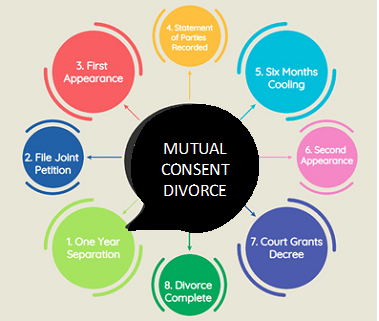
    1. Joint petition filing — both spouses file the petition together before the Family Court
    2. First motion hearing — statements are recorded, and the court records that both parties want the divorce
    3. Cooling-off period — traditionally 6 months mandatory gap between first and second motion, though the Supreme Court has allowed waiver in genuine cases where reconciliation seems impossible
    4. Second motion hearing — both parties reaffirm their consent hasn’t changed
    5. Decree of divorce — the court grants the final divorce decree

    Can the 6-Month Cooling Period Be Waived?

    Yes, and this surprises a lot of people. The Supreme Court, in Amardeep Singh v. Harveen Kaur (2017), held that the 6-month waiting period isn’t mandatory and can be waived if:

    • The couple has genuinely lived separately for over 18 months already
    • All settlement terms (alimony, custody, property) are finalized
    • Mediation attempts have failed and reconciliation seems impossible

    Documents Required

    • Marriage certificate
    • Proof of separate residence for the required period
    • Income proof of both spouses (for alimony calculation)
    • Details of children, if any, along with custody arrangement
    • Settlement agreement covering alimony and property division

    Cost and Timeline

    AspectApproximate Detail
    Court feesNominal, usually a few hundred to a couple thousand rupees
    Lawyer fees₹15,000 – ₹75,000+ depending on complexity and city
    Timeline (with waiver)As quick as 2-3 months
    Timeline (standard)6-18 months

    What Happens If One Party Withdraws Consent?

    This is where things get complicated. Either spouse can withdraw consent any time before the second motion — the divorce cannot be forced through if one party changes their mind. In such cases, the matter often converts into a contested divorce, which takes considerably longer.

    [link to related guide on child custody laws in India here]

    FAQ

    Q1. How long does mutual consent divorce take in India? Typically 6 months to 18 months, though it can be as quick as a few months if the cooling-off period is waived.

    Q2. Can mutual consent divorce happen without a lawyer? Technically yes, but given the documentation and settlement terms involved, professional guidance is strongly recommended.

    Q3. Is the 6-month cooling period always mandatory? No, courts can waive it in genuine cases where the couple has been separated long enough and settlement terms are finalized.

    Q4. What happens to child custody in mutual consent divorce? Both parties must agree on custody arrangements as part of the settlement before the divorce can proceed.

    Q5. Can one spouse back out during the process? Yes, either party can withdraw consent before the second motion, which may convert the case into contested divorce.

    Q6. Is alimony compulsory in mutual consent divorce? Not compulsory by law, but it’s usually part of the mutually agreed settlement terms filed with the court.

    Conclusion

    The mutual consent divorce process exists to spare couples the emotional and financial toll of prolonged litigation — but it only works smoothly when both sides genuinely cooperate on settlement terms upfront. If you’re considering this route, sit down and sort out alimony, custody, and property division honestly before filing; that single step prevents most delays. [link to related article on drafting a divorce settlement agreement here]

  • Ragging Isn’t “Just a College Tradition” Anymore — Legally Speaking

    Ragging Isn’t “Just a College Tradition” Anymore — Legally Speaking

    For years, ragging was brushed off as harmless “bonding” between seniors and juniors. The anti-ragging law in India exists precisely because that casual dismissal cost real students their mental health, and in tragic cases, their lives. If you’re a student, parent, or even a college administrator, understanding these rules isn’t optional anymore — it’s mandatory compliance territory.

    What Counts as Ragging Legally?

    Quick Answer: Under UGC Regulations, 2009 and various state anti-ragging laws, ragging includes any act — physical or verbal, in person or online — that causes mental or physical harm, embarrassment, or fear in a student, typically committed by senior students against juniors. It’s a punishable offence, not merely a disciplinary matter.

    The definition deliberately casts a wide net — it’s not limited to physical violence. Verbal abuse, forced tasks, public humiliation, and even certain forms of online harassment between students can qualify.

    Who Enforces Anti-Ragging Rules?

    Every college and university in India is required under UGC regulations to have:

    • An Anti-Ragging Committee — headed typically by the head of institution
    • An Anti-Ragging Squad — for surprise checks in hostels, canteens, and common areas
    • A mandatory anti-ragging affidavit from every student and parent at admission
    • Display of anti-ragging helpline numbers prominently across campus

    I’ve noticed a lot of students sign these affidavits without actually reading them — worth knowing that this isn’t just paperwork; it’s a legal acknowledgment that can be used in proceedings later.

    Punishment for Ragging

    Consequences aren’t limited to a stern warning from the principal. Depending on severity, punishments include:

    1. Suspension or expulsion from the institution
    2. Withholding of scholarships or other benefits
    3. Debarring from appearing in examinations
    4. Rustication from the institution for a specific period
    5. FIR registration and criminal prosecution under relevant IPC/BNS provisions (for serious cases involving assault, criminal intimidation, or worse)
    6. Cancellation of admission

    In genuinely severe cases — where ragging leads to grievous injury or death — the accused can face charges as serious as culpable homicide, not just college disciplinary action.

    How to File an Anti-Ragging Complaint

    1. Call the National Anti-Ragging Helpline (24×7, toll-free) — complaints can be filed anonymously
    2. Approach the college’s Anti-Ragging Committee directly with details of the incident
    3. File a written complaint with evidence (messages, witness statements, medical reports if applicable)
    4. Approach local police to register an FIR if the act involves criminal elements like assault or intimidation
    5. UGC/AICTE portals also allow online complaint registration for higher education institutions

    Picture a first-year engineering student in a hostel far from home, too scared to call family about what’s happening. That’s exactly the gap the anonymous helpline system was designed to close — students don’t need to reveal their identity to get intervention started.

    What Colleges Are Legally Required to Do

    • Investigate any ragging complaint within a strict timeframe (usually within days, not weeks)
    • Take immediate interim action against the accused pending inquiry, if the complaint appears credible
    • Report incidents to the UGC/regulatory body as mandated
    • Cannot suppress or dismiss complaints — failure to act can attract action against the institution itself, including derecognition in serious cases

    Common Myths About Anti-Ragging Law

    • “It’s only a college disciplinary matter” — false; criminal prosecution is very much possible for serious incidents
    • “Only physical ragging counts” — false; verbal, psychological, and online harassment are equally covered
    • “You need to reveal your identity to complain” — false; anonymous complaints are explicitly permitted

    [link to related guide on RTE Act 2009 and student rights here]

    FAQ

    Q1. Is ragging a criminal offence in India? Yes, in addition to disciplinary action by the institution, serious ragging incidents can lead to criminal prosecution under IPC/BNS provisions.

    Q2. Can I file an anti-ragging complaint anonymously? Yes, the national helpline and many college committees accept anonymous complaints to protect the victim’s identity.

    Q3. What is the punishment for ragging in college? Punishments range from suspension and expulsion to FIR registration and criminal prosecution, depending on severity.

    Q4. Does anti-ragging law cover online harassment between students? Yes, cyber-ragging or online harassment between students falls within the scope of anti-ragging regulations.

    Q5. Are colleges legally required to have an anti-ragging committee? Yes, UGC regulations mandate every institution to have an Anti-Ragging Committee and Squad.

    Q6. What should I do if my college ignores a ragging complaint? You can escalate directly to UGC/AICTE, the national anti-ragging helpline, or approach the police and courts if the institution fails to act.

    Conclusion

    The anti-ragging law in India exists because self-regulation by colleges alone wasn’t protecting students — and it still requires active awareness to actually work. If you or someone you know is facing ragging, don’t wait for it to “get better on its own.” Use the helpline, document everything, and escalate without hesitation. The legal framework is genuinely on your side here. [link to related article on child and student rights under education law here

  • The Law That Guarantees Your Child a Seat in School

    The Law That Guarantees Your Child a Seat in School

    Every year around admission season, parents scramble to understand one thing: does the RTE Act 2009 actually apply to their child, and how? I’ve fielded this question from relatives more times than I can count, usually right before the school application deadline, which is honestly the worst time to start figuring it out.

    What Is the RTE Act, in Simple Terms?

    Quick Answer: The Right of Children to Free and Compulsory Education (RTE) Act, 2009 guarantees free and compulsory education to every child aged 6 to 14 years in India. It also mandates that private unaided schools reserve at least 25% of seats in Class 1 for children from economically weaker sections and disadvantaged groups.

    This isn’t a vague policy statement — it’s a legally enforceable right, meaning a child (through their parent/guardian) can approach authorities if this right is denied.

    Who Is Eligible Under RTE?

    Every child between 6 and 14 years falls under this Act’s coverage. But the widely known “25% reservation” clause specifically applies to:

    • Children from Economically Weaker Sections (EWS) — usually based on family income criteria set by the respective state
    • Children from Disadvantaged Groups — SC/ST, socially/educationally backward classes, children with disabilities, and other categories defined by state rules

    Eligibility criteria (particularly income limits for EWS) vary by state, so it’s worth checking your specific state’s education department notification rather than assuming a blanket national figure.

    The 25% Reservation Rule — How It Actually Works

    This is probably the single most searched aspect of the RTE Act 2009. Here’s how it plays out practically:

    1. Private unaided schools must reserve 25% of entry-level class seats (usually Class 1 or pre-primary, depending on the school’s structure)
    2. Reimbursement is provided to the school by the government for these admissions, calculated per-child based on either the actual fee or the state-fixed per-child expenditure, whichever is lower
    3. Admissions under this quota typically happen through an online lottery/draw system managed by state education departments
    4. Required documents usually include income certificate, caste certificate (if applicable), address proof, and birth certificate

    Documents Typically Required

    • Birth certificate of the child
    • Income certificate (for EWS category)
    • Caste/category certificate (if claiming disadvantaged group benefit)
    • Residence/address proof
    • Aadhaar card (child and parent, where applicable)

    Requirements can vary slightly by state, so it’s genuinely worth checking your local state RTE portal before applying — rules aren’t perfectly uniform across India.

    What If a School Refuses RTE Admission?

    This happens more often than it should, unfortunately. If a private school refuses to admit an eligible child under the 25% quota or demands capitation fees, parents can:

    • File a complaint with the District Education Officer or Block Education Officer
    • Approach the State Commission for Protection of Child Rights (SCPCR)
    • In serious cases, file a writ petition before the High Court

    Schools found violating RTE provisions can face penalties, including cancellation of recognition in repeated or serious violations.

    Common Misconceptions About RTE

    • “RTE only applies to government schools” — false, the 25% clause specifically targets private unaided schools
    • “RTE guarantees free education forever” — the mandatory free education clause applies specifically till Class 8 (age 14), though the reserved-quota seat generally continues without fee till that stage
    • “Any low-income family automatically qualifies” — no, specific state-defined income thresholds and documentation are required

    [link to related guide on anti-ragging laws for students in India here]

    FAQ

    Q1. What age group does the RTE Act cover? Children aged 6 to 14 years are covered under the Right to Education Act, 2009.

    Q2. Do private schools have to admit EWS students for free? Yes, private unaided schools must reserve 25% of entry-level seats for EWS/disadvantaged group children, and the government reimburses part of the cost.

    Q3. Can a school reject an RTE application without reason? No, if a child meets eligibility criteria and documentation is complete, refusal without valid grounds can be challenged legally.

    Q4. Is RTE admission only for Class 1? Primarily yes, since it’s designed as an entry-level reservation, though some states extend it to pre-primary classes too.

    Q5. What income limit qualifies a family for EWS category under RTE? This varies by state — there’s no single national figure, so checking your specific state’s notification is essential.

    Q6. Can RTE benefits continue beyond Class 8? The mandatory free education guarantee is specifically for ages 6-14 (roughly till Class 8); continuation beyond that depends on school and state policy.

    Conclusion

    The RTE Act 2009 genuinely changed access to quality education for millions of children, but it only works if parents actually know how to use it. If you believe your child qualifies, don’t wait till the last week of admissions — check your state’s RTE portal early, gather documentation in advance, and don’t hesitate to escalate if a school unfairly denies admission. [link to related article on child rights and education law in India here]

  • The Question Everyone Asks After an FIR Is Filed

    The Question Everyone Asks After an FIR Is Filed

    “Is this bailable?” It’s usually the very first question people ask their lawyer once an FIR gets registered — often before they even understand what they’re accused of. Understanding the bailable vs non-bailable offence distinction genuinely changes how you approach the entire case, from strategy to expectations.

    The Basic Difference

    Quick Answer: In a bailable offence, bail is a matter of right — the police or court must grant it if requested, often on furnishing a bond. In a non-bailable offence, bail is a matter of judicial discretion, granted by a court only after considering factors like the severity of the crime and risk of the accused fleeing or tampering with evidence.

    That single word — “right” versus “discretion” — changes everything about how the process unfolds.

    Bailable Offences: What You Need to Know

    These are generally less serious offences. Examples include:

    • Simple hurt (Section 323 IPC / equivalent under BNS)
    • Defamation
    • Public nuisance
    • Cheque bounce cases in certain circumstances

    For bailable offences, even the police officer at the station can grant bail — you don’t necessarily need to go to court at all. It’s usually just a matter of furnishing a personal bond or surety.

    Non-Bailable Offences: A Different Ballgame

    These involve more serious crimes — think murder, rape, dacoity, or large-scale financial fraud. Here, bail isn’t automatic. You (or your lawyer) need to formally apply before a Magistrate or Sessions Court, and the judge decides based on the facts.

    I’ve noticed people sometimes assume “non-bailable” means “no bail ever” — that’s simply not true. It just means bail isn’t a right; it has to be argued for and granted at the court’s discretion.

    How Courts Decide Bail in Non-Bailable Cases

    Judges typically weigh:

    1. Nature and gravity of the offence
    2. Evidence available against the accused at that stage
    3. Possibility of the accused fleeing from trial
    4. Risk of tampering with evidence or influencing witnesses
    5. Criminal antecedents of the accused, if any
    6. Health, age, and personal circumstances of the accused

    Table: Bailable vs Non-Bailable at a Glance

    AspectBailable OffenceNon-Bailable Offence
    Bail as right or discretionRightDiscretion of court
    Who can grant bailPolice officer or courtOnly court (Magistrate/Sessions/HC)
    Typical examplesSimple hurt, defamationMurder, rape, large-scale fraud
    Complexity of processSimple, often quickRequires formal application and hearing

    Can Non-Bailable Offences Still Get Bail Quickly?

    Yes, and this is where the bailable vs non-bailable offence distinction gets a bit more nuanced. Depending on the specific facts — weak evidence, procedural lapses by police, or genuine grounds — courts do grant bail in non-bailable cases too, sometimes within days. It’s simply not automatic the way it is for bailable offences.

    A relative of mine was once falsely implicated in a cheating case (non-bailable) over a business dispute — with proper documentation showing the transaction was genuine, bail came through within a week. So “non-bailable” isn’t a life sentence of denial; it just means you need to make your case.

    Cognizable vs Bailable — Don’t Confuse These Terms

    A common mix-up: “cognizable” refers to whether police can arrest without a warrant, while “bailable” refers to whether bail is a right or discretion. An offence can be cognizable AND bailable, or non-cognizable AND non-bailable — they’re independent classifications, not the same axis.

    [link to related guide on the anticipatory bail process in India here]

    FAQ

    Q1. Can police grant bail directly in bailable offences? Yes, in bailable offences, the police officer at the station can grant bail without needing a court order.

    Q2. Is bail guaranteed in non-bailable offences? No, it’s at the discretion of the court, based on factors like severity of the offence and risk factors.

    Q3. What are some common examples of non-bailable offences? Murder, rape, kidnapping, dacoity, and large-scale financial fraud are typical non-bailable offences.

    Q4. Can a non-bailable offence still result in bail within a few days? Yes, depending on the evidence and circumstances, courts can and do grant bail quickly even in non-bailable cases.

    Q5. Is cognizable the same as non-bailable? No, these are separate classifications — cognizable relates to arrest without warrant, bailable relates to the right to bail.

    Q6. Do I need a lawyer to apply for bail in a bailable offence? Not strictly necessary since it’s often a straightforward process, but legal guidance helps avoid procedural delays.

    Conclusion

    Knowing the bailable vs non-bailable offence difference isn’t just legal trivia — it directly shapes what you should expect and how quickly you (or a loved one) might get relief after an FIR. If you’re ever in this situation, don’t panic at the word “non-bailable” — it simply means the fight for bail happens in court rather than at the police station. [link to related article on how to file an FIR in India here]

  • When You Fear Arrest Before It Even Happens

    When You Fear Arrest Before It Even Happens

    There’s a particular kind of anxiety that comes with knowing an FIR might be filed against you — or already has been — and you don’t know if the police will show up at your door tomorrow. That’s exactly the situation the anticipatory bail process in India is designed for.

    I’ve seen this scenario play out in family property disputes more than anywhere else — someone files a false or exaggerated complaint, and the other side panics without realizing there’s a legal remedy specifically built for this.

    What Is Anticipatory Bail?

    Quick Answer: Anticipatory bail is a pre-arrest legal protection under Section 438 CrPC (now Section 482 of BNSS) that allows a person who apprehends arrest for a non-bailable offence to seek bail in advance from the Sessions Court or High Court, preventing immediate detention if arrested.

    Essentially, it flips the usual bail process — instead of getting arrested first and applying for bail after, you secure protection before arrest even happens.

    When Should You File for Anticipatory Bail?

    You don’t need to wait for an actual FIR in every case — genuine apprehension of arrest based on credible information is enough. Common triggers include:

    • You’ve received a police notice or summons in a case
    • A complaint has been filed against you and you fear implication
    • You’ve heard through reliable sources that an FIR is being registered
    • A co-accused has been arrested and you fear you’re next

    Step-by-Step Anticipatory Bail Process

    1. Consult a criminal lawyer immediately — timing matters enormously here
    2. Draft the application clearly stating why you apprehend arrest, along with case facts
    3. File before the Sessions Court first (High Court is usually approached only if Sessions Court rejects it, or in urgent/serious cases directly)
    4. Court issues notice to the Public Prosecutor and Investigating Officer
    5. Hearing takes place — the court examines the nature of accusation, your antecedents, and possibility of you fleeing or tampering with evidence
    6. Bail granted or rejected, often with conditions like cooperating with investigation, not leaving the country, or joining questioning as required

    Factors Courts Actually Consider

    Judges don’t grant this automatically — they weigh several things:

    • Nature and seriousness of the accusation
    • Your criminal history/antecedents, if any
    • Likelihood of you fleeing from justice
    • Whether the accusation seems designed to humiliate or injure you through arrest
    • Possibility of tampering with evidence or influencing witnesses

    Has this ever happened to you or someone you know — a dispute escalating to the point where “anticipatory bail” suddenly becomes a term you’re googling at midnight? It’s more common than people admit.

    Conditions Typically Attached

    Courts usually impose conditions along with anticipatory bail, such as:

    • Making yourself available for interrogation as and when required
    • Not leaving India without court permission
    • Not directly or indirectly influencing witnesses or tampering with evidence
    • Surrendering passport in certain cases

    Anticipatory Bail Rejection — What Then?

    If the Sessions Court rejects your application, you can approach the High Court. If even that fails, and arrest happens, you’d then need to apply for regular bail post-arrest — a different, generally longer process.

    The anticipatory bail process does have limits too — courts are typically reluctant to grant it in extremely serious offences like certain economic offences of large magnitude, or cases involving grave bodily harm, though it’s not an absolute bar.

    Realistic Timeline and Costs

    StageApproximate Timeline
    Filing application1-2 days (drafting + filing)
    Sessions Court hearing1-3 weeks depending on court backlog
    High Court (if needed)2-6 weeks additional
    Lawyer feesVaries widely — ₹15,000 to ₹1,00,000+ depending on seriousness and city

    [link to related guide on bailable vs non-bailable offences here]

    FAQ

    Q1. Can anticipatory bail be filed before an FIR is registered? Yes, if you have genuine and reasonable apprehension of arrest, you don’t need to wait for an FIR to be formally filed.

    Q2. Is anticipatory bail available for all offences? No, it’s generally sought for non-bailable offences; courts may be more cautious in very serious offences but it’s not automatically barred.

    Q3. What’s the difference between anticipatory bail and regular bail? Anticipatory bail is sought before arrest to prevent detention; regular bail is applied for after arrest has already occurred.

    Q4. Can anticipatory bail be cancelled later? Yes, if the person violates conditions or if new facts emerge showing misuse of the bail, courts can cancel it.

    Q5. Do I need to appear in court personally for anticipatory bail? Generally yes, though in some situations, especially at initial stages, your lawyer may represent you with proper authorization.

    Q6. How long does anticipatory bail protection last? It can be time-bound or continue until the case is disposed of, depending on how the court frames the order.

    Conclusion

    If you genuinely fear arrest based on credible grounds, don’t sit on it hoping the situation resolves itself — the anticipatory bail process exists precisely for this window of uncertainty. Acting early, with proper legal representation, dramatically improves your chances compared to waiting until police are already at your door. [link to related article on how to file a criminal complaint in India here]

  • Being a Director Isn’t Just a Fancy Title

    Being a Director Isn’t Just a Fancy Title

    A lot of first-time founders treat the “Director” title like a badge of honour — which, fair enough, it is. But director’s liability under Companies Act 2013 is the part nobody explains clearly until something goes wrong. And by then, it’s often too late to undo the damage.

    I’ve spoken to more than one small business owner who was genuinely shocked to learn they could be personally liable for company defaults, even though the whole point of a private limited company is limited liability for shareholders.

    The Core Misconception

    Quick Answer: While shareholders enjoy limited liability, directors can be held personally liable under Companies Act 2013 for specific defaults — such as fraud, non-compliance with statutory filings, oppression of minority shareholders, or signing off on false financial statements — even though the company itself is a separate legal entity.

    That gap between “limited liability of the company” and “personal liability of directors” is where most confusion (and legal trouble) originates.

    When Can a Director Be Held Personally Liable?

    1. Fraudulent Conduct (Section 447)

    If a director is found to have participated in fraud — say, siphoning funds or falsifying records — they can face both civil liability and criminal prosecution, including imprisonment.

    2. Non-Filing of Statutory Documents

    Directors are responsible for ensuring annual returns, financial statements, and other MCA filings are done on time. Repeated defaults can lead to disqualification under Section 164, barring the person from being a director in ANY company for 5 years.

    3. Oppression and Mismanagement (Sections 241-242)

    If a director’s actions unfairly prejudice minority shareholders or run the company in a way that harms its interests, they can be held accountable before the National Company Law Tribunal (NCLT).

    4. Personal Guarantees

    This one catches people off guard — if a director personally guarantees a company loan (common for startups seeking bank credit), that liability isn’t “corporate” anymore. It’s personal, full stop, regardless of what the Companies Act says about limited liability.

    5. Signing False Statements

    Certifying financial statements or board resolutions you know to be inaccurate can expose you to liability under multiple sections, not just company law but potentially under IPC/BNS provisions for forgery or cheating too.

    Independent Directors — A Slightly Different Standard

    Here’s something worth noting: independent directors and non-executive directors who are NOT involved in day-to-day operations generally have a narrower liability — they’re only liable for acts that occurred with their knowledge, consent, or where they failed to act diligently despite being aware of an irregularity.

    This distinction matters a lot in practice. I’ve seen independent directors on startup boards get unnecessarily worried about liability for operational decisions they had zero involvement in — the law does provide them some protection, though it’s not absolute immunity.

    How Directors Can Protect Themselves

    • Maintain proper documentation of board decisions and dissent (if you disagreed with a decision, get it recorded in minutes)
    • Don’t sign financial statements or resolutions without genuinely reviewing them
    • Ensure statutory filings (annual returns, board resolutions, charge registrations) are done on time
    • Consider Directors & Officers (D&O) liability insurance — increasingly common even for small private companies now
    • Resign formally and file DIR-11/DIR-12 if you’re stepping away — an unfiled resignation can keep you liable on paper

    Penalties at a Glance

    DefaultConsequence
    Fraud (Sec 447)Imprisonment 6 months to 10 years + fine
    Non-filing of annual returnsDisqualification for 5 years (Sec 164)
    False statementsFine and/or imprisonment
    Non-compliance with NCLT ordersAdditional penalties and possible imprisonment

    [link to related guide on private limited company registration process here]

    FAQ

    Q1. Are directors always personally liable for company debts? No, generally not — the company is a separate legal entity, but personal liability arises in specific cases like fraud, guarantees, or statutory defaults.

    Q2. What is disqualification under Section 164? It bars a person from being appointed or continuing as a director in any company for 5 years due to repeated non-compliance.

    Q3. Can an independent director be held liable for company fraud? Only if it’s proven they had knowledge, consented, or failed to act diligently despite being aware of the issue.

    Q4. Does resigning as a director end all liability immediately? Not automatically — you need to properly file resignation forms (DIR-11/DIR-12); liability for past acts during your tenure can still apply.

    Q5. What is D&O insurance and do small companies need it? Directors & Officers insurance covers personal liability risks for directors; increasingly recommended even for smaller private companies today.

    Q6. Can a director go to jail for company non-compliance? Yes, in cases of serious fraud or repeated statutory violations, imprisonment is a real possibility under the Companies Act.

    Conclusion

    Director’s liability under Companies Act 2013 is one of those areas where a little knowledge upfront saves a lot of stress later. If you’re taking on a directorship — even for a friend’s startup as a “favor” — understand exactly what you’re signing up for. Read the board minutes, don’t rubber-stamp resolutions, and keep your statutory filings current. That alone eliminates most of the real risk. [link to related article on company registration compliance checklist here]

  • Starting a Company? Here’s the Real Process, Not the Textbook Version

    Starting a Company? Here’s the Real Process, Not the Textbook Version

    Most guides online make the private limited company registration process sound like a five-minute online form. It’s not quite that simple, but it’s also not as intimidating as some consultants make it seem. Having gone through this maze (and helped a few friends through it too), I can tell you the actual pain points aren’t legal — they’re paperwork delays and name approval rejections.

    Let’s get into what actually happens, step by step.

    Quick Overview of the Process

    Quick Answer: Registering a private limited company in India involves obtaining a Digital Signature Certificate (DSC), reserving a company name via the RUN or SPICe+ Part A service, filing the SPICe+ form with MoA, AoA, and required documents, and receiving the Certificate of Incorporation along with PAN and TAN — usually within 7 to 15 working days.

    Step 1: Obtain Digital Signature Certificates (DSC)

    Every proposed director needs a DSC since the entire registration process happens online through the MCA (Ministry of Corporate Affairs) portal. This typically takes 1-2 days and costs somewhere between ₹1,000 to ₹2,000 per director, depending on the certifying agency.

    Don’t skip this thinking you can “do it later” — half the delays I’ve seen happen because someone’s DSC wasn’t ready when it mattered.

    Step 2: Name Reservation

    You’ll propose 1-2 unique names through the SPICe+ Part A service. The name must not resemble an existing company or trademark too closely.

    Here’s an honest tip: keep a backup name ready. I’ve seen perfectly good name choices rejected simply because they were “too similar” to an existing registered entity — even in a completely different industry.

    Step 3: Drafting MoA and AoA

    The Memorandum of Association (MoA) defines what your company can legally do, and the Articles of Association (AoA) lay out internal governance rules. For most straightforward businesses, standard templates work fine, but if you have multiple founders with specific equity or exit arrangements, get these customized by a professional.

    Step 4: Filing SPICe+ Part B

    This single integrated form now covers company incorporation, PAN, TAN, EPFO, ESIC, and GST registration (optional) all at once. You’ll need:

    • Identity and address proof of all directors
    • Proof of registered office address (utility bill + NOC from owner, or rent agreement)
    • Photographs of directors
    • DIN (Director Identification Number) details

    Step 5: Certificate of Incorporation

    Once the Registrar of Companies (RoC) approves everything, you receive the Certificate of Incorporation (CoI) — this is your company’s official birth certificate, complete with a Corporate Identification Number (CIN).

    The private limited company registration process is technically complete at this stage, though a few post-incorporation compliances follow immediately after.

    Documents You’ll Actually Need

    • PAN card of all directors and shareholders (mandatory for Indian nationals)
    • Passport (mandatory for foreign nationals/NRIs)
    • Address proof — Aadhaar, voter ID, or driving license
    • Latest utility bill for registered office (not older than 2 months)
    • Passport-size photographs
    • NOC from the property owner if the office is rented

    Cost and Timeline Breakdown

    ItemApproximate Cost
    DSC (per director)₹1,000 – ₹2,000
    Government filing feesVaries by authorized capital
    Professional/CA fees₹5,000 – ₹15,000
    Total timeline7 – 15 working days

    Costs vary quite a bit depending on your state and authorized share capital, so treat this as a rough ballpark, not gospel.

    Post-Incorporation Compliance You Shouldn’t Ignore

    • Open a company bank account within 30 days
    • Deposit subscribed capital and file INC-20A (declaration of commencement of business)
    • Appoint a statutory auditor within 30 days of incorporation
    • Maintain statutory registers from day one — don’t wait till the first audit

    [link to related guide on director’s liability under Companies Act here]

    FAQ

    Q1. How long does private limited company registration take in India? Typically 7 to 15 working days if all documents are in order and there are no name rejection issues.

    Q2. What is the minimum capital required to start a private limited company? There’s no minimum paid-up capital requirement anymore under current company law.

    Q3. Can a single person register a private limited company? No, a private limited company needs a minimum of 2 directors and 2 shareholders (can be the same 2 people).

    Q4. Is GST registration mandatory during company incorporation? No, but it’s now optional to apply for it directly through the SPICe+ form if you plan to start operations immediately.

    Q5. What happens if I don’t file INC-20A on time? The company cannot legally commence business or borrow funds, and penalties can apply for continued non-compliance.

    Q6. Can NRIs or foreign nationals be directors in an Indian private limited company? Yes, but at least one director must be a resident of India as per the Companies Act.

    Conclusion

    The private limited company registration process genuinely isn’t as scary as it looks on paper — most delays come down to name rejections and incomplete documentation, not legal complexity. Get your DSCs sorted early, keep backup name options ready, and double-check your address proof documents before filing. Do that, and you’re realistically looking at a company incorporated within two weeks. [link to related article on GST registration process for startups here]

  • When Ordinary Remedies Aren’t Enough

    When Ordinary Remedies Aren’t Enough

    Sometimes the government — or even a lower court — oversteps its authority, and there’s no simple appeal available. That’s exactly when the types of writ petition available under the Constitution become your best (and sometimes only) option. This remedy isn’t just for lawyers; ordinary citizens use it more often than most people realize.

    I remember reading about a case where a college denied admission to a student despite her meeting every criterion — a writ petition got her seat back within weeks, faster than any regular civil suit could have managed.

    What Is a Writ Petition, Really?

    Quick Answer: A writ petition is a formal request filed before the Supreme Court (under Article 32) or a High Court (under Article 226) asking the court to issue an order protecting a fundamental right or, in the case of High Courts, any legal right. There are five types of writs: Habeas Corpus, Mandamus, Prohibition, Certiorari, and Quo Warranto.

    Article 32 vs Article 226 — Not the Same Thing

    This distinction confuses even some law students. Article 32 lets you approach the Supreme Court directly, but only for enforcement of fundamental rights — nothing else. Article 226 gives High Courts a much wider power; they can issue writs for enforcement of fundamental rights AND any other legal right.

    So technically, High Courts have broader writ jurisdiction than the Supreme Court itself. Counterintuitive, but true.

    The 5 Types of Writ Petition Explained

    Let’s go through each one, because this is really the crux of what people search for.

    1. Habeas Corpus (“You may have the body”)

    Used when someone is illegally detained. The court orders the detaining authority to produce the person and justify the detention. If there’s no lawful ground, the person is released immediately.

    2. Mandamus (“We command”)

    Directs a public official or authority to perform a duty they’re legally obligated to but have failed to do. For example, if a municipal officer refuses to issue a certificate you’re entitled to, mandamus can force action.

    3. Prohibition

    Issued by a higher court to a lower court or tribunal, stopping it from proceeding with a case that’s outside its jurisdiction. It’s preventive — used before the lower court passes its final order.

    4. Certiorari

    Similar to prohibition but issued after the lower court or tribunal has already passed an order — it quashes that order if it was made without or in excess of jurisdiction, or in violation of natural justice.

    5. Quo Warranto (“By what authority”)

    Challenges a person’s right to hold a public office. If someone is occupying a government post without proper legal qualification or authority, this writ can remove them.

    How to File a Writ Petition — The Basic Process

    1. Identify whether your right violated is fundamental (go to SC or HC) or a broader legal right (HC only)
    2. Draft the petition clearly stating facts, the right violated, and the relief sought
    3. File it along with supporting affidavits and documents
    4. The court may issue notice to the opposite party (usually a government authority)
    5. Hearing takes place, and the court decides whether to issue the writ

    Unlike a regular suit, writ petitions skip a lot of the lengthy trial process — that’s exactly why they’re preferred in urgent rights violations.

    Real-World Situations Where People File Writs

    • Illegal arrest or detention beyond permitted hours (Habeas Corpus)
    • Government department delaying a passport or pension without reason (Mandamus)
    • A tribunal hearing a matter it has no jurisdiction over (Prohibition)
    • An administrative body passing an order without giving you a chance to be heard (Certiorari)
    • Someone appointed to a government post without meeting eligibility criteria (Quo Warranto)

    [link to related guide on fundamental rights under Article 14 here]

    FAQ

    Q1. How many types of writ petitions are there in India? There are five: Habeas Corpus, Mandamus, Prohibition, Certiorari, and Quo Warranto.

    Q2. What’s the difference between Article 32 and Article 226 writs? Article 32 (Supreme Court) covers only fundamental rights, while Article 226 (High Courts) covers both fundamental and other legal rights.

    Q3. Which writ is used for illegal detention? Habeas Corpus is used to challenge illegal or unlawful detention of a person.

    Q4. Can a private citizen file a writ against a private company? Generally writs are issued against the State or public authorities, though in limited cases they can apply if the private body performs a public function.

    Q5. How long does a writ petition take to resolve? It varies, but writs are generally faster than regular civil suits since they bypass lengthy trial procedures.

    Q6. What is the difference between Prohibition and Certiorari? Prohibition is preventive, stopping a lower court before it decides; Certiorari is corrective, quashing an order already passed.

    Conclusion

    Understanding the types of writ petition available to you isn’t just legal trivia — it’s a genuinely powerful tool when ordinary government processes fail or overstep their bounds. Whether it’s an illegal detention, bureaucratic inaction, or an unauthorized appointment, there’s likely a writ designed exactly for your situation. If you believe your rights are being violated by a public authority, this is usually your fastest path to relief. [link to related article on Article 14 and the right to equality here]