There’s a lot of stigma and misunderstanding around what suspension actually means for a government employee. It’s not a punishment in itself — it’s a precautionary measure pending inquiry. Understanding the actual suspension rules governing government employees helps you respond correctly instead of panicking or, worse, staying silent when you should be asserting your rights.
What Does Suspension Legally Mean?
Quick Answer: Suspension of a government employee is a temporary measure, typically imposed when a disciplinary inquiry or criminal case is pending, that bars the employee from performing official duties while continuing to draw a subsistence allowance. It is governed by service conduct rules like the CCS (CCA) Rules, 1965, for central government employees, or equivalent state rules.
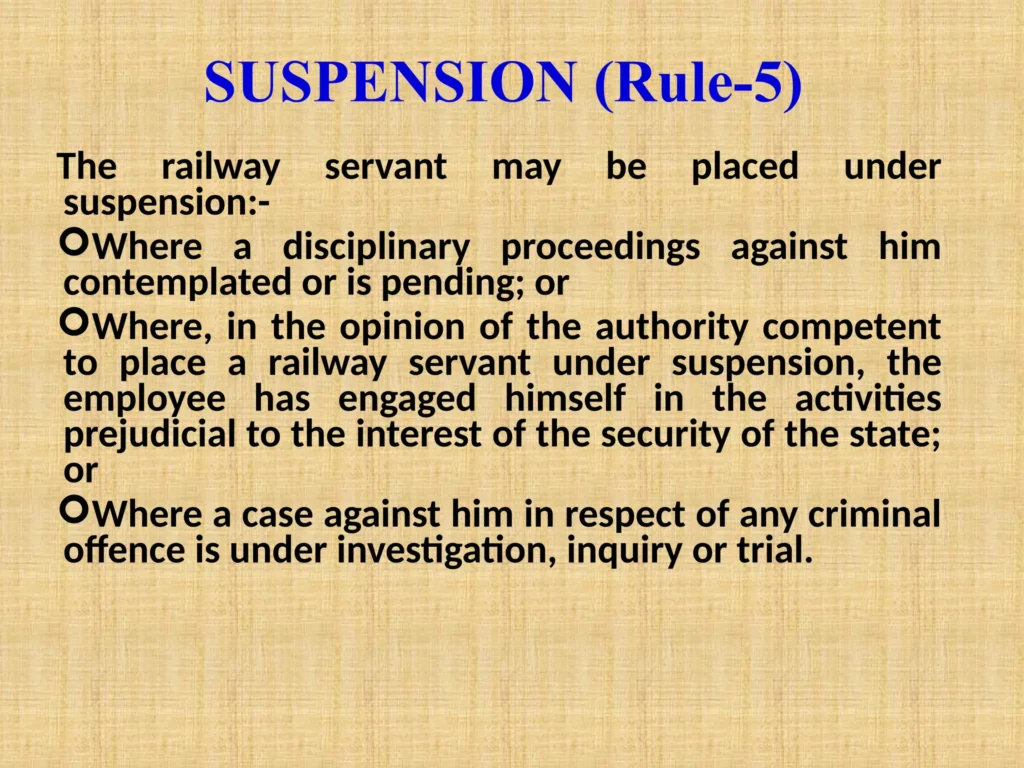
Grounds on Which Suspension Can Be Ordered
An employee can typically be placed under suspension when:
- A disciplinary proceeding is contemplated or pending against them
- A criminal case involving moral turpitude is under investigation or trial
- The employee is detained in custody for more than 48 hours
- Continuing in the post could hamper the ongoing inquiry or is against public interest
Importantly, suspension is a discretionary power of the disciplinary authority — it isn’t automatic just because a complaint exists.
Subsistence Allowance — You’re Not Left Without Income
This is something many suspended employees don’t fully understand. Under most service rules, a suspended employee continues to receive a subsistence allowance — typically around 50% of basic pay for the first three months, which can increase or decrease based on how the inquiry progresses and whether delays are attributable to the employee.
If the inquiry drags on beyond six months without the employee being at fault for delays, the subsistence allowance can be enhanced further, sometimes up to 75%.
How Long Can Suspension Last?
There’s no fixed maximum period under most rules, but courts have repeatedly held that indefinite suspension is unfair and against principles of natural justice. Review of suspension orders is typically required:
- Every 90 days by a Review Committee under CCS (CCA) Rules
- The authority must justify continued suspension at each review, not simply extend it mechanically
I’ve seen cases where suspended employees successfully challenged prolonged suspension in tribunals specifically because the department failed to conduct these mandatory periodic reviews.
Rights of a Suspended Government Employee
- Right to receive subsistence allowance regularly
- Right to a fair and timely disciplinary inquiry — not indefinite delay
- Right to periodic review of the suspension order
- Right to be informed of specific charges, if a formal chargesheet is issued
- Right to legal representation or a defense assistant during departmental inquiry proceedings
- Right to challenge suspension before the Central/State Administrative Tribunal or High Court if it appears arbitrary or unjustified
Legal Remedies Available
If you believe your suspension is unjustified, prolonged without cause, or procedurally improper, you can:
- File a representation with the disciplinary/appellate authority first
- Approach the Central Administrative Tribunal (CAT) or State Administrative Tribunal, where applicable
- File a writ petition before the High Court under Article 226, particularly for violation of natural justice
- Challenge non-review of suspension if the mandatory 90-day review hasn’t been conducted
Tribunals have consistently held that suspension cannot be used as a punitive tool disguised as a “precautionary measure” — if the facts show mala fide intent or unreasonable delay, courts do intervene.
[link to related guide on filing a departmental appeal against disciplinary action here]
FAQ
Q1. Does a suspended government employee still get salary? Not full salary, but they receive a subsistence allowance, typically around 50% of basic pay, which can be revised over time.
Q2. Can suspension continue indefinitely without review? No, most service rules require periodic review, typically every 90 days, and indefinite suspension without review can be legally challenged.
Q3. Can a government employee be suspended without a formal chargesheet? Yes, suspension can precede the chargesheet if a disciplinary proceeding is contemplated, though the chargesheet must follow within a reasonable time.
Q4. Where can a suspended employee challenge an unfair suspension order? Through departmental representation, the Central/State Administrative Tribunal, or a writ petition before the High Court.
Q5. Is suspension considered a punishment under service law? No, it’s technically a precautionary measure, not a punishment, though its practical impact on the employee can feel similarly severe.
Q6. Can suspension affect pension or retirement benefits? It can affect calculations temporarily during the suspension period, but this is typically resolved based on the outcome of the disciplinary inquiry.
Conclusion
Being placed under suspension as a government employee is genuinely stressful, but it’s not the end of your career, and it comes with real, enforceable rights — subsistence allowance, periodic review, and a fair inquiry process. If your suspension seems to be dragging on without justification, don’t just wait it out passively; file a representation, and escalate to the tribunal if needed. The law does provide checks against arbitrary or indefinite suspension. [link to related article on departmental appeal process for government employees here]