Not every divorce has to be a courtroom battle. When both spouses genuinely agree the marriage isn’t working, the mutual consent divorce process offers a far less painful route than contested litigation. I’ve seen couples drag out bitter fights for years over things they could’ve settled in six months through mutual consent — mostly because nobody explained the process to them clearly.
What Is Mutual Consent Divorce?
Quick Answer: A mutual consent divorce, under Section 13B of the Hindu Marriage Act (or equivalent provisions for other personal laws), allows both spouses to jointly file for divorce when they agree the marriage has broken down and have lived separately for at least one year. It’s typically resolved in 6 months to 18 months, much faster than contested divorce.
Eligibility Requirements
Before filing, a few conditions must genuinely be met:
- The couple must have been living separately for at least one year
- Both parties must mutually agree that they cannot live together
- They must agree on all terms — alimony, custody (if children involved), and property division
If even one of these is missing, courts can refuse to treat it as a mutual consent case, and it may get converted into contested proceedings instead.
Step-by-Step Process
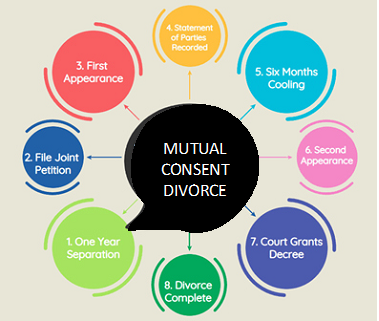
- Joint petition filing — both spouses file the petition together before the Family Court
- First motion hearing — statements are recorded, and the court records that both parties want the divorce
- Cooling-off period — traditionally 6 months mandatory gap between first and second motion, though the Supreme Court has allowed waiver in genuine cases where reconciliation seems impossible
- Second motion hearing — both parties reaffirm their consent hasn’t changed
- Decree of divorce — the court grants the final divorce decree
Can the 6-Month Cooling Period Be Waived?
Yes, and this surprises a lot of people. The Supreme Court, in Amardeep Singh v. Harveen Kaur (2017), held that the 6-month waiting period isn’t mandatory and can be waived if:
- The couple has genuinely lived separately for over 18 months already
- All settlement terms (alimony, custody, property) are finalized
- Mediation attempts have failed and reconciliation seems impossible
Documents Required
- Marriage certificate
- Proof of separate residence for the required period
- Income proof of both spouses (for alimony calculation)
- Details of children, if any, along with custody arrangement
- Settlement agreement covering alimony and property division
Cost and Timeline
| Aspect | Approximate Detail |
| Court fees | Nominal, usually a few hundred to a couple thousand rupees |
| Lawyer fees | ₹15,000 – ₹75,000+ depending on complexity and city |
| Timeline (with waiver) | As quick as 2-3 months |
| Timeline (standard) | 6-18 months |
What Happens If One Party Withdraws Consent?
This is where things get complicated. Either spouse can withdraw consent any time before the second motion — the divorce cannot be forced through if one party changes their mind. In such cases, the matter often converts into a contested divorce, which takes considerably longer.
[link to related guide on child custody laws in India here]
FAQ
Q1. How long does mutual consent divorce take in India? Typically 6 months to 18 months, though it can be as quick as a few months if the cooling-off period is waived.
Q2. Can mutual consent divorce happen without a lawyer? Technically yes, but given the documentation and settlement terms involved, professional guidance is strongly recommended.
Q3. Is the 6-month cooling period always mandatory? No, courts can waive it in genuine cases where the couple has been separated long enough and settlement terms are finalized.
Q4. What happens to child custody in mutual consent divorce? Both parties must agree on custody arrangements as part of the settlement before the divorce can proceed.
Q5. Can one spouse back out during the process? Yes, either party can withdraw consent before the second motion, which may convert the case into contested divorce.
Q6. Is alimony compulsory in mutual consent divorce? Not compulsory by law, but it’s usually part of the mutually agreed settlement terms filed with the court.
Conclusion
The mutual consent divorce process exists to spare couples the emotional and financial toll of prolonged litigation — but it only works smoothly when both sides genuinely cooperate on settlement terms upfront. If you’re considering this route, sit down and sort out alimony, custody, and property division honestly before filing; that single step prevents most delays. [link to related article on drafting a divorce settlement agreement here]