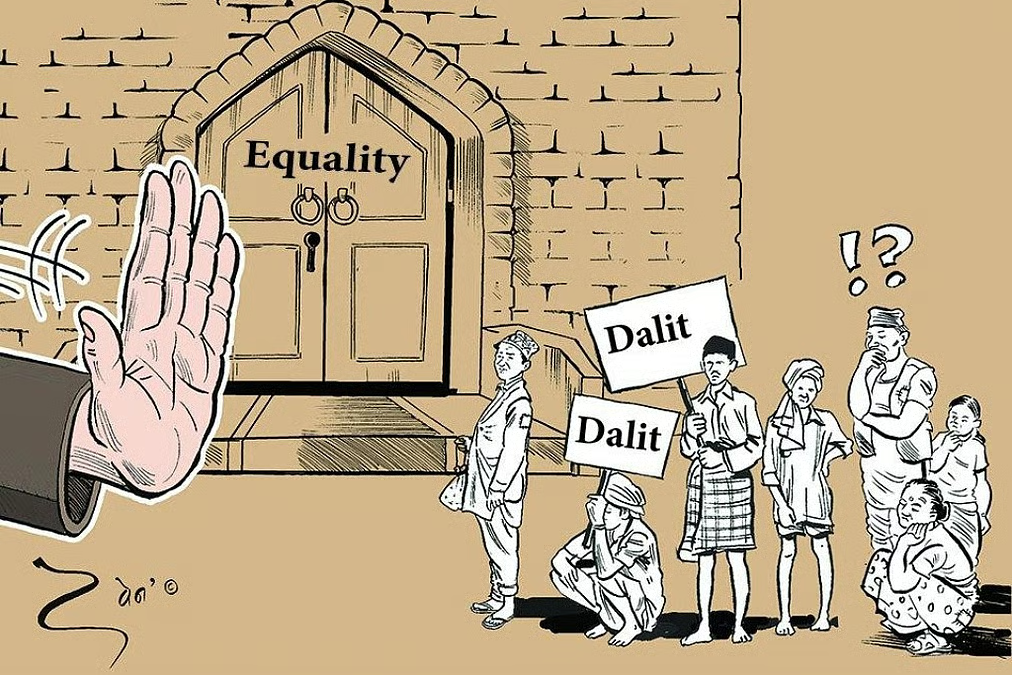
Ever wondered why a government policy that treats two similarly placed people differently can be struck down in court? That’s Article 14 right to equality at work — arguably the most litigated, most quoted, and most misunderstood provision of the Indian Constitution.
I’ll be honest, when I first studied this in law school, I thought “equality” meant treating everyone identically. It doesn’t. And that one misunderstanding causes a lot of confusion even among working professionals.
What Does Article 14 Actually Say?
Quick Answer: Article 14 guarantees that the State shall not deny to any person equality before law or the equal protection of the laws within the territory of India. It applies to both citizens and non-citizens, and covers natural as well as legal persons like companies.
Two distinct concepts hide inside this one line: “equality before law” (a British/Dicey-influenced negative concept — no one is above the law) and “equal protection of laws” (an American-influenced positive concept — similar treatment for similarly situated people).
Equality Doesn’t Mean Identical Treatment
This is the part that trips people up. Article 14 permits reasonable classification. The State can absolutely treat different groups differently — as long as the classification is based on an intelligible differentia and has a rational nexus with the object of the law.
Take reservation policies, for instance. Are they “unequal”? On the surface, maybe. But courts have consistently held they satisfy the twin test of reasonable classification because they aim to correct historical disadvantage — that’s the rational nexus.
The Two-Test Framework Courts Use
Courts generally test any law challenged under Article 14 using:
- Intelligible Differentia — is there a real, identifiable basis distinguishing one group from another (not vague or arbitrary)?
- Rational Nexus — does that classification actually connect logically to what the law is trying to achieve?
If a law fails either test, it’s struck down as violative of the right to equality. I’ve always found this test elegant in theory but genuinely tricky to apply — reasonable people can (and do) disagree on what counts as “rational.”
Landmark Judgments That Shaped Article 14
A few cases every law student and citizen should know:
- E.P. Royappa v. State of Tamil Nadu (1974): Introduced the “arbitrariness” test — anything arbitrary is inherently unequal and violates Article 14.
- Maneka Gandhi v. Union of India (1978): Linked Article 14 with Article 21, holding that any procedure depriving personal liberty must be fair, just, and reasonable — not arbitrary.
- Indra Sawhney v. Union of India (1992): Dealt extensively with reservation and the limits of reasonable classification.
- Navtej Singh Johar v. Union of India (2018): Used Article 14 (along with 15 and 21) to decriminalize consensual same-sex relationships, holding Section 377 arbitrary and discriminatory.
Where Article 14 Applies in Everyday Life
You’d be surprised how often this Article comes up outside constitutional law textbooks:
- Challenging arbitrary government tender rejections
- Unequal pay for equal work claims by government employees
- Discriminatory eligibility criteria in public exams or recruitment
- Arbitrary transfer or suspension orders against civil servants
- Unequal application of taxation or licensing rules between similarly placed businesses
A friend of mine, a government school teacher, once challenged a transfer order that seemed to single her out unfairly compared to colleagues in identical postings. The tribunal actually relied on Article 14’s arbitrariness doctrine to grant relief. It’s not just theory — it genuinely protects people in daily administrative disputes.
What Article 14 Does NOT Guarantee
It’s worth being clear-eyed here — Article 14 isn’t a blanket promise of identical outcomes. It doesn’t mean:
- Equal distribution of wealth or resources
- Uniform laws for every profession or category of people
- A right to demand the same benefit given to someone else if your situation is genuinely different
[link to related guide on fundamental rights under the Indian Constitution here]
FAQ
Q1. What is the main idea behind Article 14? It guarantees equality before law and equal protection of laws to every person within India’s territory, subject to reasonable classification.
Q2. Does Article 14 apply to foreigners in India? Yes, unlike some fundamental rights limited to citizens, Article 14 protects “any person,” including foreign nationals.
Q3. Can the government treat two groups differently under Article 14? Yes, if the classification is based on intelligible differentia with a rational nexus to the law’s objective.
Q4. How is Article 14 connected to Article 21? Courts, especially in Maneka Gandhi’s case, held that procedures affecting life and liberty under Article 21 must also satisfy the fairness test under Article 14.
Q5. Is reservation a violation of Article 14? No, courts have upheld reservation as valid reasonable classification aimed at substantive equality, not a violation.
Q6. Can companies claim rights under Article 14? Yes, Article 14 extends to legal persons like companies, not just individuals.
Conclusion
Article 14 right to equality is far more layered than the simple phrase suggests — it’s the backbone courts use to strike down arbitrary state action, unfair classifications, and discriminatory policies. If you ever feel a government decision treated you unfairly compared to someone in your exact position, this is the Article your lawyer will likely reach for first. Worth remembering the next time you hear “equality before law” thrown around casually. [link to related article on writ petitions under Article 32 here]